


Publications

Measurement of muscle passive stiffness in vibration-exposed groundskeepers
Authors: Nathan Chen 1, Seunghyeon Yang 2, Justin Leach 3, Jonghwa Oh 2
Affiliations:
- Department of Environmental Health Sciences, School of Public Health, University of Michigan, Ann Arbor, MI, USA
- Department of Environmental Health Sciences, School of Public Health, University of Alabama at Birmingham, Birmingham, AL, USA
- Department of Biostatistics, School of Public Health, University of Alabama at Birmingham, Birmingham, AL, USA
Journal: International Archives of Occupational and Environmental Health - April 2026, Volume 99, Article no. 22 (DOI: 10.1007/s00420-026-02214-6)
-
Field & Applications:
- Medical
- Occupational Healthcare
- Musculoskeletal health
- Musculoskeletal disorder
- Injury prevention
Objective: Currently, there is no standardized method to quantify musculoskeletal health of hand-arm vibration syndrome (HAVS). This study evaluated passive stiffness (PS) of the abductor pollicis brevis (APB) muscle among groundskeepers and examined the potential relationship of the PS with lifetime hand-arm vibration (HAV) exposure of the workers.
Methods: PS of APB muscle was measured using a myotonometer among 17 groundskeepers and 10 office workers for 3 days. Study participants’ HAV exposure, demographic information, social history, and health-related information were pulled from our previous studies conducted in parallel with the present study. Linear mixed models were employed to estimate the association between lifetime HAV exposure dose and PS.
Results: The average PS for right and left hands was 509.7 N/m (range 402.2–752.9 N/m) and 501.7 N/m (range 380.4–660.7 N/m), respectively, in the exposure group and 422.0 N/m (range 365.0–517.2 N/m) and 430.3 N/m (range 359.2–591.9 N/m), respectively, in the reference group. A significant positive association between lifetime HAV exposure and PS was observed in the multivariable linear mixed model after adjusting for age, body mass index, and race/ethnicity (right hand: β = 6.972 and p-value = 0.0128; left hand: β = 9.039 and p-value = 0.0108).
Conclusions: A significant association between lifetime HAV exposure and PS was found, supporting PS measurement using myotonometry as a promising health indicator for muscular disorders induced by HAV.
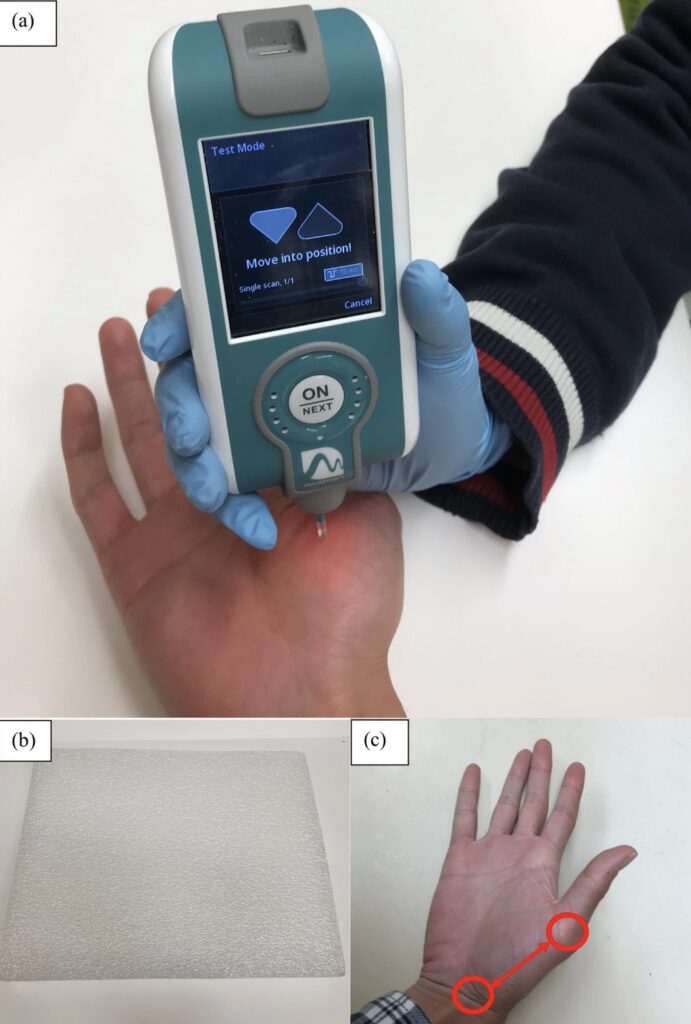
Figure 1. Passive stiffness (PS) of abductor pollicis brevis (APB) muscle was measured by a myotonometer on b an assigned surface at c the midpoint between thumb carpometacarpal joint and metacarpophalangeal joint
Keywords: hand-arm vibration, hand-arm vibration syndrome (HAVS), groundskeepers, myotonometer, passive stiffness
The present study (1) showed that the PS measurement on thumb muscle through the myotonomteric method may be a promising non-invasive, early muscular health indicator for HAVS among power tool operators, in particular groundskeepers, (2) will help better understand the pathophysiological mechanisms of the muscular disorders of HAVS that the vibration-induced injuries on the APB muscles may lead to muscle fibrosis, and (3) showed the need of further investigations with larger sample sizes and prospective studies to help establish a reliable exposure-response relationship between HAV exposure and PS.