


Publications

Feasibility of a hand-held myotonometry device for measuring biomechanical muscle parameters in horses
Authors: Gesiane Ribeiro 1, 2, Ricardo Agricola 1, 3, Maria Margarida Formosinho Sanchez 4, Filipe R. Ramos 5, 6, Joao Borges 1, Joao Abrantes 7, Jose Prazeres 1
Affiliations:
- Research in Veterinary Medicine (I-MVET), Faculty of Veterinary Medicine, Lusofona University, Lisbon, Portugal
- Animal and Veterinary Science Centre (CECAV), Faculty of Veterinary Medicine, Lusofona University, Lisbon, Portugal
- Centre for Interdisciplinary Research in Animal Health (CIISA), Faculty of Veterinary Medicine, University of Lisbon, Lisbon, Portugal
- Faculty of Veterinary Medicine, Lusofona University, Lisbon, Portugal
- Centre for Statistics and Applications (CEAUL), Faculty of Sciences, University of Lisbon, Lisbon, Portugal
- Centre for Transdisciplinary Studies for Development (CETRAD-Europeia HUB), Faculty of Social Sciences and Technology, Universidade Europeia, Lisbon, Portugal
- Digital Laboratories for Environments and Human Interactions (HEI-Lab), School of Psychology and Life Sciences, Lusofona University, Lisbon, Portugal
Journal: American Journal of Veterinary Research - May 2026 (DOI: 10.2460/ajvr.26.02.0050)
-
Field & Applications:
- Animal studies
- Medical
- Sport
- Musculoskeletal health
- Muscle symmetry
- Injury prevention
- The MyotonPRO is a tool that could contribute to various fields of equine medicine, just as it has already been applied in research for different purposes in human medicine, such as monitoring postinjury recovery, musculoskeletal rehabilitation, sports medicine, and training monitoring.
- The use of myotonometry for routine measurement of these parameters in high-performance equine athletes could help anticipate preventive measures to avoid injuries.
- Monitoring muscle biomechanical parameters can also be useful in rehabilitation follow-up as it allows for the objective quantification of muscle characteristics associated with clinical progress and helps guide therapeutic interventions.
Objective: To evaluate the feasibility of a hand-held myotometry device for measuring the biomechanical parameters (frequency, stiffness, and decrement) of the longissimus dorsi muscle in the thoracolumbar region of healthy horses.
Methods: Data were obtained from 50 adult horses. The biomechanical parameters were measured using a MyotonPRO device in triple-scan mode. Measurements were recorded on both sides, with the horses standing square. The analysis focused on whether there were differences between the sides and correlations between the variables.
Results: The mean muscle frequency (hertz) was 21.66 ± 2.88 on the left side and 21.45 ± 2.75 on the right side. The mean stiffness (N/m) was 535.94 ± 82.87 on the left side and 525.41 ± 75.15 on the right side. The mean decrement on the left was 1.68 ± 0.34, and the mean decrement on the right was 1.71 ± 0.26. There were no significant differences between the sides for any parameter, indicating symmetry between them. On the left side, correlations were found between biomechanical parameters and age and body score.
Conclusions: The MyotonPRO device is a tool that can be used to measure muscle tone, stiffness, and decrement in horses.
Clinical Relevance: Validating a portable tool for measuring biomechanical parameters can make muscle assessment in horses more objective and contribute to diagnosis as well as injury prevention and recovery monitoring.
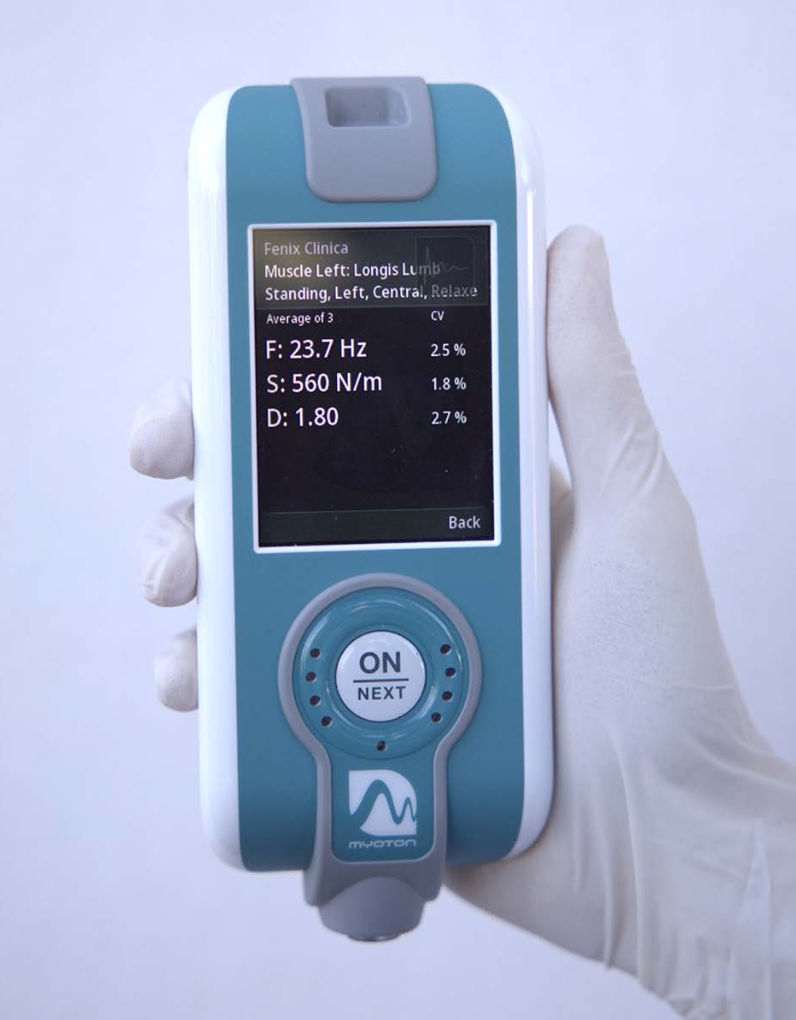
Figure 1. MyotonPRO hand-held digital palpation device (Myoton AS). CV = Coefficient of variation. D = Decrement. F = Frequency. S = Stiffness.
Keywords: back pain, equine, elasticity, muscle tone, stiffness
The results of this study indicate that the MyotonPRO device can be used to measure frequency, stiffness, and decrement in the longissimus dorsi muscles of normal horses. Further studies are needed to establish normal values in other regions of the horse’s back and to better understand the effects of biological factors on these parameters.