


Publications

Comparative Effects of Femoral Nerve Neurodynamic Techniques and Static Stretching on Quadriceps Muscle Mechanical Properties
Authors: Pinelopi Anestaki, Dimitris Mandalidis, Eleftherios Paraskevopoulos
Affiliations: Laboratory of Sports Physical Therapy, Division of Sport Medicine and Biology of Exercise, School of Physical Education and Sport Science, National and Kapodistrian University of Athens, 17237 Athens, Greece
Journal: - August 2026, Volume 13, Issue 8, Article no. 927 (DOI: 10.3390/bioengineering13080927)
-
Field & Applications:
- Sport
- Treatment evaluation
- Physiotherapy
- Musculoskeletal health
- Musculoskeletal rehabilitation
- Neuromuscular response
Background: Neurodynamic techniques are commonly used to improve neural mobility and musculoskeletal function, but their effects on muscle mechanical properties remain unclear. This study investigated the acute effects of femoral nerve slider, femoral nerve tensioner, and static stretching interventions on the rectus femoris and vastus medialis muscles.
Methods: Thirty healthy adults (18–35 years) were non-randomly allocated using a predetermined alternating sequence to a femoral nerve slider (n = 10), femoral nerve tensioner (n = 10), or static stretching group (n = 10). No sham or no-intervention control group was included. Muscle mechanical properties were assessed before and immediately after the intervention using the MyotonPRO (Myoton AS, Tallinn, Estonia). Outcomes included muscle tone, stiffness, logarithmic decrement, relaxation time, and creep. A three-way mixed repeated-measures ANOVA was performed.
Results: No statistically significant differences in pre–post changes were detected among the three intervention groups for any of the examined mechanical parameters. Significant main effects of time were found for stiffness (p = 0.026) and creep (p = 0.005), indicating overall reductions from pre- to post-assessment. Significant time × muscle interactions were identified for relaxation time (p = 0.029) and creep (p = 0.002), indicating different temporal patterns between the rectus femoris and vastus medialis. Following Holm adjustment of the follow-up comparisons, the pre–post reduction in the vastus medialis remained statistically significant for creep but not for relaxation time. The rectus femoris demonstrated greater stiffness and logarithmic decrement values, whereas the vastus medialis exhibited greater relaxation time values.
Conclusions: No statistically significant differences in immediate pre–post changes in quadriceps muscle mechanical properties were detected among the femoral nerve slider, femoral nerve tensioner, and static stretching groups. Temporal and muscle-specific patterns were observed for selected mechanical parameters; however, these findings should not be interpreted as evidence of equivalence between the interventions.
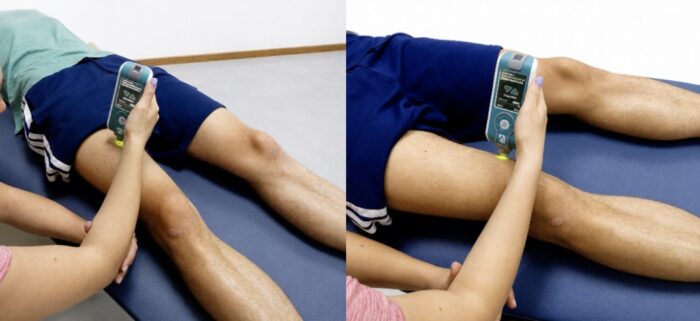
Figure 4. Assessment of rectus femoris (left) and vastus medialis (right) mechanical properties using the MyotonPRO device.
Keywords: neurodynamics, femoral nerve, MyotonPRO, muscle mechanical properties
The present study found no statistically detectable intervention-specific differences in the immediate MyotonPRO-derived mechanical properties of the rectus femoris and vastus medialis following femoral nerve slider, femoral nerve tensioner, or static stretching procedures in healthy young adults. Significant temporal changes were observed for stiffness and creep, while muscle-specific temporal responses were identified for relaxation time and creep. However, in the absence of a sham or no-intervention control condition, these temporal changes cannot be attributed specifically to the interventions and may partly reflect non-specific influences associated with repeated measurement, participant relaxation, or the passage of time. Furthermore, the absence of significant intervention-specific interactions should not be interpreted as evidence of equivalence among the three procedures. The observed differences between the rectus femoris and vastus medialis suggest that muscle-specific mechanical characteristics may warrant further investigation; however, their physiological and clinical significance remains uncertain. As the present study included healthy participants and did not assess pain, range of motion, neural mechanosensitivity, strength, or functional performance, the findings should not be extrapolated directly to symptomatic populations or clinical effectiveness. Future studies should investigate longer-term responses, include sham or no-intervention conditions and symptomatic populations, and examine whether changes in muscle mechanical properties are associated with clinically and functionally meaningful outcomes.