


Publications
Stiffness and Running Performance: From the Tissue to the Body: A Narrative Review
Authors: Lola Masson 1, Guillaume Y. Millet 2, 3, Hugo A. Kerherve 1
Affiliations:
- Univ Rennes 2, Inria, M2S-EA 7470, 35000 Rennes, France
- Laboratoire Interuniversitaire de Biologie de la Motricite, Universite Jean Monnet Saint-Etienne, Lyon 1, Universite Savoie Mont-Blanc, 42023 Saint‑Etienne, France
- Institut Universitaire de France (IUF), Paris, France
Journal: Sports Medicine - March 2026 (DOI: 10.1007/s40279-026-02406-7)
-
Field & Applications:
- Sport
- Muscle development / Performance
- Musculoskeletal health
- Review
Running is a unique mode of locomotion, a gait with clear ground contact and aerial phases, during which the body experiences dynamic deformations at various scales. At each stride, the centre of mass lowers and rises under the action of articulated body segments with muscles and tendons stretching and shortening, inducing tissue loading. The capacity to resist such deformations, to dissipate or transmit forces or to store and release energy are all commonly lumped together within the concept of stiffness. Stiffness is commonly considered to be a major performance factor in running as it may impact running economy.
This review (i) provides a brief overview of the various definitions and methods of measurement of the lower limbs’ stiffness in the context of running; (ii) synthesizes the current understanding of how stiffness, measured at the various scales, relates to running performance and economy; (iii) analyses the effects of running-induced fatigue on stiffness and their subsequent consequences on running performance and (iv) explores how stiffness can be adjusted to enhance running performance via acute strategies (equipment, warm-up) or long-term training.
Current evidence suggests a direct link between stiffness and running economy, but the underlying mechanisms remain unclear across measurement scales. Despite the variety of methods available, stiffness at the tissue level is still underexplored, particularly in relation to performance and running-induced fatigue. More research is needed to identify an optimal stiffness level and clarify how acute or chronic interventions may beneficially—or detrimentally—modulate stiffness and running performance.
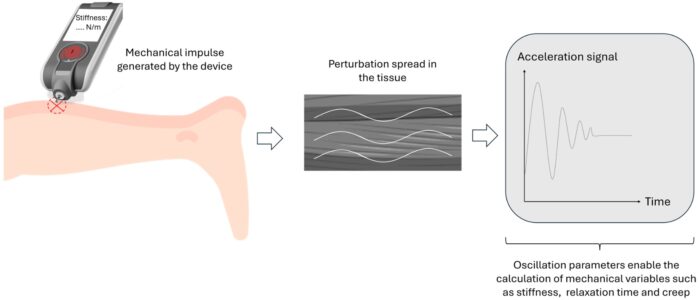
Figure 7. Myotonometry principle to assess mechanical parameters of muscular or tendinous tissues
Whereas current evidence indicates a direct link between stiffness and running economy, the mechanisms underlying this relationship remain poorly understood, likely reflecting the fragmented and uneven body of research across levels of analysis on stiffness-related parameters.
[…]
Finally, methodological studies are also necessary to quantify the accuracy and reliability of the different methods measuring stiffness at the tissue level (SWE, myotonometry, tensiomyography), understand the extent to which the different metrics correlate with each other and determine their implications for running performance. Studies involving different stiffness measurements, from the tissue to the whole body, could help increase our understanding of the role of stiffness in running economy and performance.