


Publications
Inter- and Intra-Rater Reliability of Myotonometric Assessment of the Mechanical Properties of Caesarean Section Scar Skin Using the MyotonPRO With an L-Shaped Probe
Authors: Monika Nosiadek 1, Jaroslaw Marusiak 2, 3, Karolina Gamon 4, Dawid Baczkowicz 3
Affiliations:
- Fizjoterapia Monika Nosiadek, Rybnik, Poland
- Division of Kinesiology, Department of Physiotherapy in Movement System Dysfunctions and Kinesiology, Faculty of Physiotherapy, Wroclaw University of Health and Sport Science, Wroclaw, Poland
- Faculty of Physical Education and Physiotherapy, Opole University of Technology, Opole, Poland
- Voivodship Specialist Hospital No. 3 in Rybnik, Rybnik, Poland
Journal: Skin Research & Technology - January 2026, Volume 32, Issue 1, Article no. e70315 (DOI: 10.1111/srt.70315)
-
Field & Applications:
- Medical
- Skin / Dermatology
- Women's health
- Methodology
- Reliability
- By providing quantifiable data, myotonometry enhances the precision of treatment monitoring, potentially leading to more tailored therapeutic approaches. Furthermore, minimal clinically significant differences between raters underscore the suitability of myotonometry in multi-practitioner settings and larger research studies.
- The high inter-rater and reasonable intra-rater reliabilities observed in this study provide a strong foundation for the incorporation of myotonometry into routine scar assessments. Using an L-shaped probe enables clinicians to conduct reliable assessments of scar skin pliability that are less dependent on subjective interpretation, as seen in POSAS-based assessments.
Background: Myotonometry is a noninvasive method for assessing the mechanical properties of soft tissues, including muscles and skin. The L-shaped probe, designed specifically for skin assessment, may be useful for evaluating caesarean section (C-section) scars. However, reliability data for MyotonPRO measurements of C-section scars with this probe are limited. This study aimed to evaluate the inter-rater and intra-rater reliability of measuring the mechanical properties of C-section scar skin using the MyotonPRO with the L-shaped probe.
Materials and Methods: Twenty-five women (23–42 years) with C-section scars were examined. Two raters conducted the myotonometric assessments over two consecutive days. Measurements were taken with the participant supine, using the L-shaped probe at six points around the scar (three above, three below; positioned at the scar’s endpoints and centre), each tested in three directions (right, left and upward/downward). Reliability was analysed using the intraclass correlation coefficient (ICC) with 95% confidence intervals (CIs), the standard error of measurement (SEM), minimal detectable change (MDC), coefficient of variation (CV) and Bland–Altman plots.
Results: Inter-rater reliability was good to excellent (ICC = 0.75–0.90), while intra-rater reliability was moderate to good, with slightly lower ICCs for consecutive-day measurements. SEM, MDC and CV values supported these findings, showing lower measurement error and narrower variability ranges between raters than within repeated measurements by the same rater.
Conclusion: The MyotonPRO with the L-shaped probe provides reliable inter- and intra-rater measurements of C-section scar skin mechanical properties, making it a valuable tool for scar evaluation.
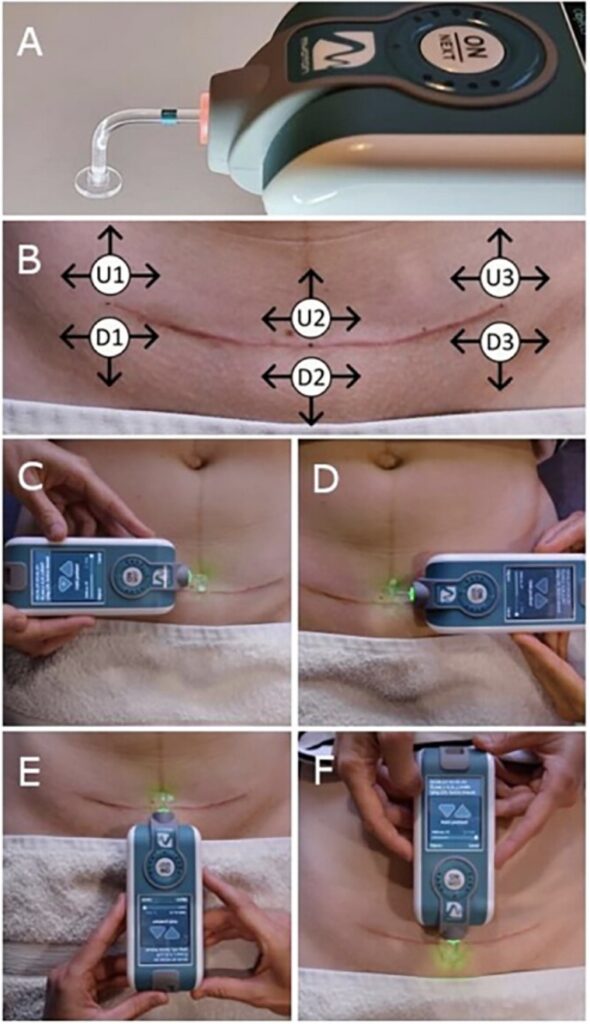
Figure 1. MyotonPRO device with an L-shaped probe (A); three measurement points up the scar (U1–U3) and down the scar (D1–D3), with testing directions indicated by arrows (B); assessment of the mechanical properties of the caesarean scar in four directions: right (C), left (D), cranial (E) and sacral (F).
In conclusion, this study demonstrates that the MyotonPRO device, with an L-shaped skin probe, provides good to excellent inter-rater reliability and moderate to good intra-rater reliability for assessing the viscoelastic properties of C-section scar skin. These findings support the use of myotonometry as a reliable tool for scar assessment with potential applications in both clinical practice and research.