Technology

MyotonPRO Device 

The patented MyotonPRO technology brings evidence-based medicine to the field of muscle assessment by enabling the non-invasive, cost-effective, quick and easy measurement of superficial skeletal muscles and other soft biological tissues.

Physicians and sports therapists are able to use MyotonPRO to measure objectively individual skeletal muscles, ligaments and tendons as well as different regions of any soft tissue. The device detects even small changes in the state and properties of tissues to a high degree of accuracy.


Method for Measuring

The method of measuring with MyotonPRO consists of three main parts:

  • Exertion of a mechanical impulse
  • Registration of a co-oscillation
  • Computation of parameters

The table below describes the measurement and computation process in greater detail:
STEPDESCRIPTION
1 Application of pre-pressure - A constant pre-pressure is applied by the device to the skin surface directly above the muscle being measured, thereby slightly compressing the subcutaneous superficial tissue layer.
2 Exertion of a quick-release mechanical impulse - A light quick-release mechanical impulse is exerted by the device at constant mechanical force to the tissue layer directly above the muscle being measured. This compressed layer then transmits the impulse to the muscle below.
3 Recording of the co-oscillation - The muscle responds to the exterior mechanical impulse by a damped natural oscillation. The co-oscillation of the muscle, compressed tissue layer and the probe are recorded by an accelerometer in the form of an acceleration graph.
4 Processing of the raw signal - The raw signal is then processed to filter out the low and high frequencies that are not characteristic of the muscle's natural oscillation.
5 Computation of parameters- The filtered oscillation curve is used as the basis to compute the parameters characterizing tone or tension as well a biomechanical and viscoelastic properties. There are five parameters classified into the three following groups:

1. State of Tone or Tension: 

  • Natural Oscillation Frequency [Hz], characterizing Tone or Tension

2. Biomechanical properties:

  • Logarithmic Decrement of natural oscillation, characterizing Elasticity
  • Dynamic Stiffness [N/m]

3. Viscoelastic properties:

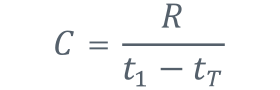
  • Creep-ability (Deborah number)
  • Mechanical Stress Relaxation Time [ms]

The mechanical impulse exerted on the muscle is of short duration (15 milliseconds) and involves a light mechanical force (up to 0.6 N). Hence, it does not cause residual mechanical deformation nor neurological reaction of the muscle or tissue being assessed.


MyotonPRO is a Class 1 Medical Device according to European Medical Device Directive 93/42/EEC+2007/47/CE. The MyotonPRO device IS TO BE USED FOR RESEARCH PURPOSES ONLY and is not for use in clinical, diagnostic or therapeutic procedures!

Please click on the link to view Myoton's Declaration of ConformityDeclaration of Conformity MyotonPRO.pdf (180 KiB).  


Myoton AS
Reg: 10533818


Peterburi Rd 2F
Tallinn 11415, Estonia


Tel: +372 6030 806
Fax: +372 6030 722